In a previous post, we discussed how to write to an inmate without sharing your home address. While using a PO box or a mail service isn’t a mandatory rule, it is a smart strategy for maintaining privacy and ensuring consistent communication.
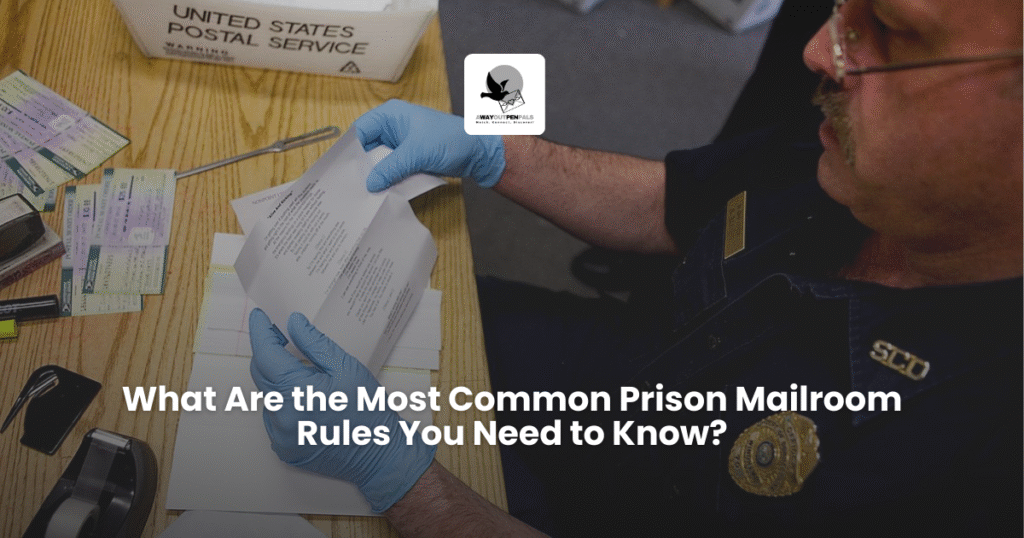
However, privacy is only one piece of the puzzle. To ensure your letters actually reach their destination, rather than being confiscated, rejected, or destroyed, you must navigate a strict set of regulations. Following common prison mailroom rules is the only way to guarantee your mail makes it to the other side safely.
In the process of sharing their best wishes with their penpal behind the bars, some people lose track of reality. Overcome with real emotion, they tend to ignore the mailroom rules.
But don’t worry. It happens to the best of us. In this blog, we will look at the rules you mustn’t ignore when writing to someone behind the bars.
A common sentiment shared in this Quora conversation highlights that “the mailroom doesn’t care about your feelings; they care about contraband.” Remember, consistency and “clean mail” are your best friends when building a connection.
Let’s take a look at some common prison mailroom rules you mustn’t forget when writing to inmates.
The Golden Rule: Standard Envelope Formatting & Required ID Numbers
In the outside world, a missing zip code might cause a delay; in the prison system, a missing ID number means your letter is headed for the trash.
When you write a prisoner, the mailroom staff uses the ID number to verify the recipient’s identity in a database that may house thousands of people with similar names.
A critical thing to remember is that most facilities will not accept mail without a clear, verifiable return address. This isn’t just a suggestion; it’s a security requirement to prevent anonymous harassment or the introduction of unknown materials into the facility.
Here are a few things you cannot skimp on.
- Inmate Full Legal Name: Always use the name they are registered under in the system, even if they go by a nickname.
- Department of Corrections (DOC) or Booking Number: This is the most vital piece of info. Without it, the mail is undeliverable.
- Full Facility Address: Include the unit or housing block if you know it, as this speeds up the internal sorting process.
- Legible Return Address: Your full name and address must be in the top left corner of the envelope.
- No Extra Markings: Do not draw on the envelope. No “SWAK” (Sealed With A Kiss) or doodles; keep it strictly professional.
Official guidelines from the Oregon Department of Corrections confirm that mail must strictly include the recipient’s State ID (SID) and a full return address to ensure delivery. To meet security standards, the facility requires professional, plain white envelopes and explicitly bans markings like crayons or markers, noting that any deviation from these rules will lead to immediate rejection by the mailroom.
The “Clean Mail” Policy: Dealing with Stickers, Glitter, and Scent
If you want to know how to send “clean mail” to prison pen pals, the best advice is to keep it boring. This may seem a little counterintuitive, but it is actually true.
While you might want to spray a letter with perfume or add a heart sticker to cheer up your prison pen pals, these are major red flags for mailroom staff.
The reason for this intensity?
Contraband! In recent years, facilities have seen a rise in “soaked mail,” where paper is laced with liquid chemicals. Consequently, most facilities now have a zero-tolerance policy for anything that isn’t plain paper and ink.
- No Adhesives: This includes stickers, labels, Washi tape, or even the sticky part of a Post-it note.
- No Scents: Perfumes, colognes, or even heavy essential oils can cause a letter to be rejected immediately.
- No “Artistic” Additions: Glitter, glue, paint, or white-out are strictly forbidden.
- Crayon and Markers: Many facilities ban these because they can be used to hide messages or substances beneath the wax/ink layer. Stick to blue or black ballpoint pen.
- Lipstick Marks: Never “seal it with a kiss.” Lipstick is an organic substance and is treated as a biohazard or a vehicle for contraband.
According to research published by the National Institute of Justice, the detection of drugs like synthetic cannabinoids in mail has led to much stricter screening processes, including the banning of almost all physical embellishments.
Sharing Memories: Rules Regarding Photos and Printed Materials
Photos are the most prized possessions for people in prison.
Of course! They trigger certain emotions.
They offer a window into a world they can no longer see.
However, there are strict rules regarding what those photos can show and how they are printed.
- Size Matters: Most prisons only allow 4×6 photos. Anything larger may be considered a “poster” and rejected.
- No Polaroids: These are banned in almost every facility because the layered backing of a Polaroid can be used to smuggle flat contraband.
- Content Restrictions: No nudity, partial nudity, or “sexually suggestive” poses. Even a photo of a child in a bathtub or a person in a bikini can be flagged.
- No Hand Signs: Avoid any photos where people are making hand gestures that could be interpreted as gang-related.
- Print-Outs: You can often send articles or song lyrics, but they must be printed on standard white 8.5×11 paper. Avoid sending more than 3-5 pages at a time to stay under weight limits.
Research from the Federal Bureau of Prisons (BOP) indicates that inmates are generally allowed to possess personal photographs, but they are subject to “volumetric” limits—meaning they can only have a certain number (often 25) before they have to send some home or have them destroyed.
Navigating the System: State, Federal, and Private Facility Regulations
It is important for you to understand that not all prisons are created equal. That’s a reality.
When you look at different prison pen pal programs, you’ll find inmates in state-run, federal-run, and privately-run facilities.
Each has its own rulebook, and what works for a state prison in Texas might not work for a federal facility in New York. Here is all you need to know.
- Federal Prisons (BOP): Usually have a uniform set of rules nationwide, making it easier to predict what is allowed once you learn the basics.
- State Prisons: These vary wildly. Some states, like Pennsylvania and Florida, have moved to “Digital Mail Centers” where your physical letter is sent to a third party, scanned, and the inmate only sees a black-and-white printout or a digital version on a tablet.
- Private Facilities: Managed by companies like CoreCivic or GEO Group, these facilities may have even stricter rules regarding packages and publications to reduce labor costs in the mailroom.
- Books and Magazines: Almost all facilities require these to be sent directly from the publisher (like Amazon or Barnes & Noble). You cannot mail a book yourself.
A comparative study by U.S. Courts on prison conditions and rules highlight how administrative variations can lead to different levels of “due process” regarding rejected mail.
The Digital Era: Writing to a Prisoner Online
In 2026, many people prefer to write to a prisoner online through platforms like JPay, CorrLinks, or Securus.
While this is faster, it doesn’t mean the rules disappear. Electronic messages are still subject to the same scrutiny as physical mail.
When you write a prisoner electronically, you have to be aware of “keyword triggers.” Mailroom software automatically flags certain words related to security, drugs, or escape.
- Cost Per Stamp: Digital “stamps” cost money. It’s often cheaper than physical postage but can add up if you send long messages.
- Attachment Limits: You can often attach a photo, but it must still follow the content rules mentioned earlier.
- Monitoring: Every word is archived. Do not discuss anything you wouldn’t want a correctional officer to read aloud.
- Delayed Delivery: Just because it’s an “email” doesn’t mean it’s instant. It still goes through a digital “mailroom” queue for screening.
The prison e-messaging market is a virtual duopoly, with Securus (via its JPay brand) and ViaPath (formerly GTL) controlling over 81% of the industry. Securus leads the sector with contracts in 22 states; half of all systems offering the service, while ViaPath serves another fifteen, leaving the vast majority of inmate communications in the hands of these two corporations.
Don’t forget to check out: General U.S. Prison Mail Rules To Know Before Writing To Inmates
Why Consistency Matters: The Impact of Your Letters
If you want your letter to be effective, you have to be consistent.
That’s right! If you want your letters to bring about a positive change in the life of the inmate, you have to write at least once or twice a month.
Maintaining a consistent correspondence with someone behind bars isn’t just a kind gesture; it’s a lifeline. When the “outside world” remains present through regular letters, it fundamentally changes an inmate’s experience and their future success.
Here are four key reasons why consistency matters:
1. Psychological Stability and Hope
Prison is an environment defined by isolation and routine. Receiving mail at a predictable interval provides a powerful psychological “anchor.” It gives an inmate something to look forward to, which reduces rates of depression and anxiety. Knowing a letter is coming every Tuesday, for example, can be the difference between despair and resilience.
2. Successful Reentry and Reduced Recidivism
The Department of Justice and various correctional studies consistently show that inmates who maintain strong ties with the outside world are significantly less likely to return to prison.
- The Logic: Consistent communication preserves social skills and keeps the inmate “tethered” to society.
- The Result: They have a support system ready to help them find housing and employment upon release.
3. Safety and Status Within the Facility
In the social hierarchy of a prison, an inmate who regularly receives mail is often perceived differently by both staff and other prisoners. It signals that the individual has a support network that cares about their well-being. This “visibility” can sometimes serve as a subtle layer of protection, as it shows the person is not forgotten or “disposable” in the eyes of the public.
4. Combatting “Institutionalization”
Over time, the rigid rules of prison can strip away a person’s sense of self, a process known as institutionalization. Regular letters filled with mundane details about your life—what you ate, a movie you saw, or family updates help the inmate maintain their identity as a father, daughter, or friend, rather than just a number in a database.
Final Word
Writing to a prisoner is a journey of patience and empathy, but by mastering the mailroom’s quirks, you ensure your voice is heard behind the walls. If you’re ready to make a difference and start your journey, visit A Way Out Penpals to find your first connection.
FAQ Section
Can I send stamps to a prisoner?
Generally, no. Most facilities consider loose stamps to be a form of currency or a security risk. Inmates must purchase their own stamps through the commissary.
What happens if my mail is rejected?
The mailroom will typically send a “rejection notice” to both the sender and the inmate. It will state the reason (e.g., “contains glitter”). You can usually correct the issue and resend the letter.
Can I send cash in a letter?
Never. Sending cash or personal checks through the mail is a violation in almost every facility. Use authorized services like Western Union, GTL, or JPay to deposit money into an inmate’s account.
How do I find a prisoner’s ID number?
Most states have an “Inmate Locator” on their Department of Corrections website. You will need their first and last name to search.
Is it safe to use my home address?
While most pen pals are simply looking for connection, many writers choose to use a P.O. Box for an added layer of privacy and security when first starting out.