It’s important to understand the general U.S. prison mail rules before you write to an inmate.
Why?
Because your first instinct might be to make your mail look beautiful and thoughtful. You want it to reflect the care, affection, and consideration you have for the person you’re writing to.
So naturally, you might reach for glitter, perfume, colorful markers, staples — all that jazz — to make your letter look and feel special.
The only problem is… all of that is completely banned.
We humans, tend to believe there’s always a little wiggle room in life — a 10% exception somewhere. A tiny space where things can be sparkly, scented, or “just this once.”
But the reality — the grim one — is that there are always people who look for loopholes, exploit gaps, and push boundaries in ways that ruin it for everyone else.
…and that very behavior, ladies and gentlemen, is what triggers collective punishment.
Now, let’s circle back to why glitter, perfume, crayons, and similar items are absolutely banned, so the logic behind all of this makes sense.
When the law allows inmates penpals to receive letters, it creates a legitimate, meaningful way for the outside world to connect with them. That’s great — until a handful of people figure out they can smuggle drug-soaked letters into prisons, where they’re sold and consumed. Imagine that business model for a second.
And if you’re wondering why guards couldn’t detect it by smell…
Well, if you haven’t guessed it already…
Those letters were PERFUMED.
So, here are some of the general U.S. prison mail rules that exist today. Some of these rules were created proactively, and others read like lessons learned the hard way.
General U.S. Prison Mail Rules (Before You Look at Each State)
All U.S. prisons follow a shared security framework set by DOC policies, federal guidelines, and mailroom protocols.
Each state adds its own rules, but the core principles are nearly universal. They explain why certain items are allowed, restricted, or banned across the country.
Here’s a summary table that will help you navigate as well:
- All Mail is Screened For Security (Federal Standard)
- Most Prisons Now Use Mail Scanning Systems
- Plain White Envelopes and Plain Paper Are Standard Everywhere
- Stickers, Glue, Glitter, Tape, and Staples Are Almost Always Banned
- Photos Are Allowed. But With Strict Limitations.
- Books Must Come Directly From Verified Vendors
- Cash, Checks, Stamps, and Gift Items Are Universally Prohibited
- Sexual Content, Violent Imagery, and Gang Symbols Are Nationally Restricted
- Mail Containing “Unknown Substances” Is Rejected Automatically
- Everything Must Include the Inmate’s Correct Name + ID Number
Now let’s get into the details.
1. All Mail is Screened For Security (Federal Standard)
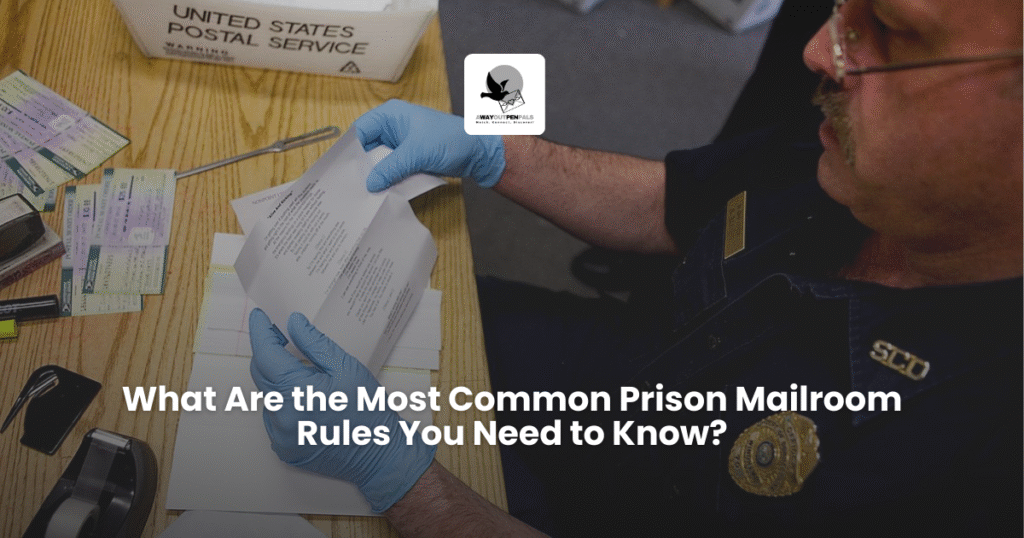
Every prison, federal, state, or county, screens incoming mail for contraband.
This is required under:
- 28 CFR § 540.14–540.18 (Federal Bureau of Prisons mail management rules)
- State DOC mailroom policies, which closely mirror federal guidelines
Why it matters:
When mails are not screened, bad things can make their way into prisons. For example, drugs.
The Prison Violence Task Force Report shows that soaking letters in drugs is one of the increasingly popular tactics to introduce drugs into facilities.
Smiths Detection, a threat detection and security screening technology company, tells the remaining story of what happens when the drug-soaked paper makes its way into the facility. It’s cut up and sold for 100s of Dollars. For inmates, that’s a loooooootta money.
Things like that and more are the reason why prisons must screen mail to effectively prevent escape plans, coded messages, drug smuggling, gang communication, and the introduction of prohibited items.
This is why:
- Envelopes may be opened
- Photos are inspected
- Pages are flipped
- Books must come from vendors.
2. Most Prisons Now Use Mail Scanning Systems
Across the U.S., prisons increasingly use third-party digital mail processing (TextBehind, Pigeonly, Smart Communications, Securus Digital Mail Center).
States using digital mail for some or all facilities include PA, FL, MI, GA, IN, ND, TN, AL, WI, MS, MO, LA, VA, and several counties nationwide.
The reason why it’s becoming the national trend is that Digital mail restricts contraband from entering jails.
However, not all inmates have a tablet. So those who don’t have one still receive their mail, but only in black and white printed copies.
So, what does this all mean for you as a sender?
- Your physical letter may be scanned, not physically delivered
- Inmates receive black-and-white photocopies or digital versions
- Originals are destroyed after scanning
This varies by state, but it’s becoming the national trend.
3. Plain White Envelopes and Plain Paper Are Standard Everywhere
Every state DOC emphasizes the same rule: Use plain white or manila envelopes and plain, unstylized paper.
It’s because:
- Colored paper can hide inks, drugs, or coded messages
- Decorative envelopes can contain contraband
- Security staff must easily inspect all surfaces
Examples from DOC policies:
- Texas (TDCJ): Only white postcards and white envelopes allowed
- California CDCR: Prohibits greeting cards with layers, textures, or embellishments
- Florida DOC: Requires standard white paper only in many facilities
This rule is nearly universal.
Don’t forget to check out: Ideas For Fun Things to Send to an Inmate
4. Stickers, Glue, Glitter, Tape, and Staples Are Almost Always Banned
Ooh boy. If “banned for a reason” were a rule.
These items are almost always banned, mainly because of two reasons:
- Security risk
They create hiding places for drugs (especially Suboxone strips).
- Prevent tampering
Tape/stickers can conceal substances or messages.
So, does that meant that if your mail doesn’t post a security risk and doesn’t conceal any subsctances or hidden messages, would it be okay for you using glue, glitter, tape, staples, etc?
BIG NO, and this rule is consistent across all states.
- Ohio DOC bans stickers, tape, glue, and glitter outright.
- Michigan DOC bans staples, paperclips, and adhesives.
- Pennsylvania DOC prohibits all decorative elements after drug-laced adhesives incidents in 2018.
5. Photos Are Allowed. But With Strict Limitations.
Most U.S. prisons allow standard 4×6 photos, but all states impose restrictions based on safety and sexual content rules.
Common restrictions:
- No Polaroids (they have a detachable backing that can hide drugs)
- No nudity or sexually explicit imagery
- No gang signs, money, drugs, weapons
- Usually, a limit of 5–10 photos per envelope
DOC examples:
- Federal Prisons (BOP) allow photos but ban Polaroids and explicit content.
- Arizona DOC: max 5 photos per mailing.
- Georgia DOC: bans lewd clothing, smoking depictions, and illegal activity.
These restrictions stem from BOP Program Statement 5266.11 and state-level mailroom regulations.
6. Books Must Come Directly From Verified Vendors
This is national policy.
Reasons:
- Prevent smuggling through hollowed-out books
- Prevent the introduction of contraband soaked into the pages
Standard rules:
- Books must come from Amazon, Barnes & Noble, or the publisher
- No used books
- No hardcovers (banned in many states for security reasons)
Examples:
- Texas TDCJ: only approved vendors; many restrictions on genres
- Florida DOC: vendor-only books
- New York DOCCS: banned used books; vendor-only policy
This rule is nearly universal, though details vary.
7. Cash, Checks, Stamps, and Gift Items Are Universally Prohibited
Why?
Security + economic fairness + contraband prevention
All DOCs mandate:
- No cash
- No checks
- No stamps
- No credit/gift cards
- No food
- No clothing
- No electronics
Reasoning:
- Cash and stamps function as “prison currency” → contraband risk
- Packages could hide drugs
- Financial transactions must go through official channels (JPay, Securus, GTL, AccessCorrections)
Federal BOP highlights this in Program Statement 4500.12 (Trust Fund/Deposit Fund Manual).
8. Sexual Content, Violent Imagery, and Gang Symbols Are Nationally Restricted
This is covered under:
- BOP Program Statement 5266.11
- State DOC “obscenity” rules
- Security Threat Group (STG) regulations
Prohibited content includes:
- Nudity
- Pornographic material
- Graphic violence
- Gang signs, hand symbols, tattoos, colors
- Criminal activity depictions
Why?
Prisons must prevent:
- STG activity
- Harassment
- Escalation of conflict
- Disruption of rehabilitation programs
This applies to both letters and photos.
Don’t forget to check out: What are some platforms to connect with female prison pen pals?
9. Mail Containing “Unknown Substances” Is Rejected Automatically
If the mail contains:
- Perfume
- Lipstick marks
- Oils
- Powder
- Unidentified stains
…it is rejected instantly because DOCs have reported dozens of incidents where perfume/cologne was used to mask drug odor or where liquids carried substances like synthetic cannabinoids.
For example, if you refer to page 14, it clearly states that it’s unfortunate that some people use these items (perfumes, artwork, ink, crayon, glue, glitter, etc) in a manner that violates policy and creates an unsafe environment for everyone.
Examples:
- Florida DOC (2021): multiple K2 cases linked to scented letters.
- Michigan DOC and Pennsylvania DOC implemented automatic rejection after similar incidents.
10. Everything Must Include the Inmate’s Correct Name + ID Number
Again, a universal rule.
Reasons:
- Prevent misdelivery
- Maintain recordkeeping
- Avoid security breaches
- Comply with the DOC chain-of-custody
If either the name or ID is missing or wrong, the mail is rejected in nearly every state.